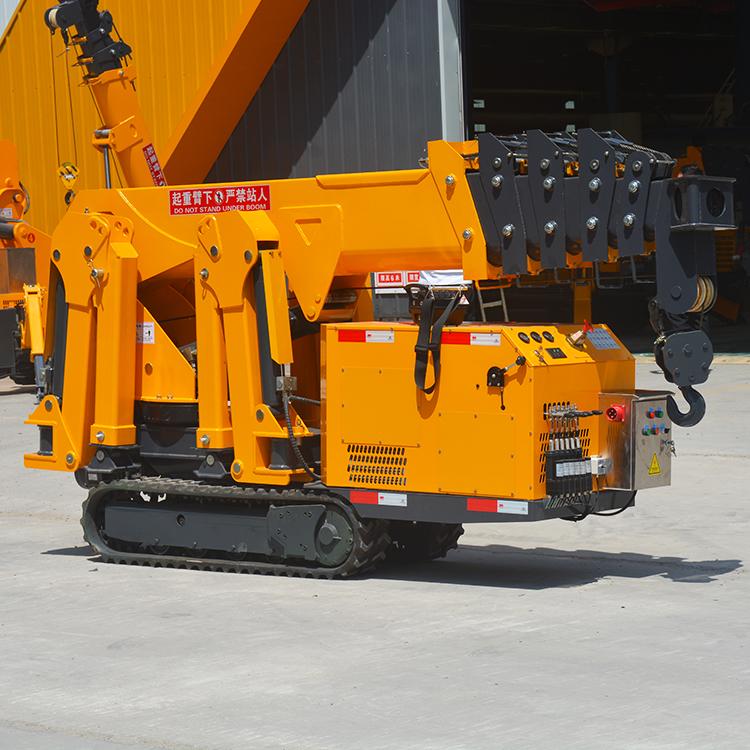
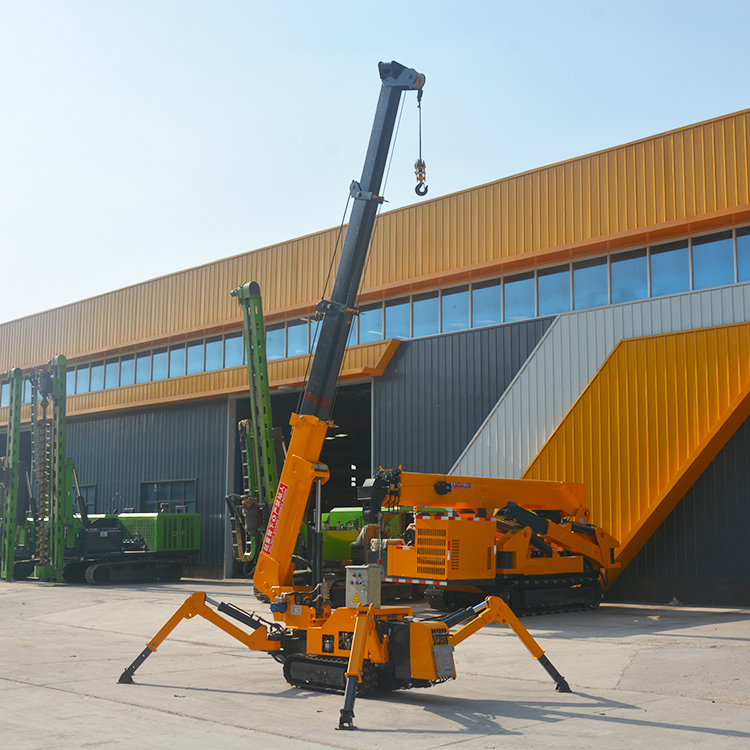
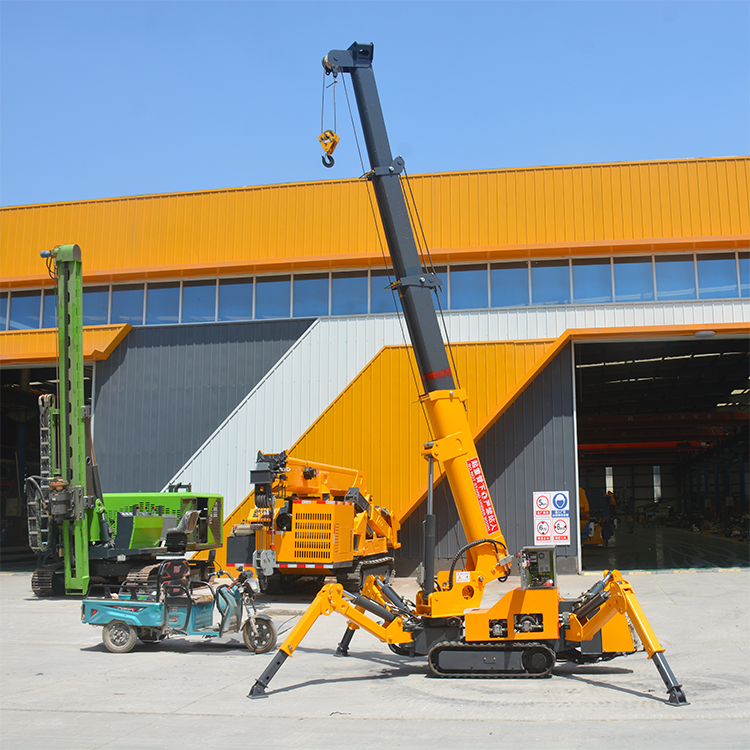
As a China Mini Spider Crane manufacturer, we build this 1.2-ton class unit for crews working in backyards, alleyways and finished interiors where a truck crane cannot even park. Folded width is 0.65 m, so it rolls straight through a standard single door. Four hydraulic outriggers spread the load and protect the slab underneath. Factory-direct pricing and a 12-month warranty ship from China.
Picture a truck-mounted crane. Now shrink the carrier to something the size of a ride-on mower, bolt four legs onto the corners, and hinge a two-section boom on the turntable. That is roughly where this machine sits in the lifting family. The "spider" nickname comes from the stance it takes once those legs are out — low body, four angled outriggers, boom tucked between them.
We have shipped these units to roofers, glaziers, landscapers and shop-fitters. The one thing all of them said in the first phone call: "I can't get a normal crane in here."
That is the whole point. It does not try to out-lift a 25-ton rough-terrain machine. It goes where the big machine stops — the 1.1 m gate, the stairwell, the third-floor corridor, the courtyard packed with parked cars.
Two numbers tell you most of the story before you read anything else. Travel width when folded, and net weight. Ours come in around 0.65 m wide and 1.3ton with the standard counterweight. If your access route is wider than 0.8 m and your floor can take a 1-tonne point load on each outrigger pad, this class of machine will almost always do the job.
Body, Boom and the Outrigger Layout
The chassis is a welded steel frame with a low centre of gravity — deliberately low, because a tall body on a narrow footprint tips too easily when you swing a load over the side. A rotating turntable sits on top, and the boom on ours is a two-section hydraulically telescoping design with a maximum outreach of about 5.35 m at reduced capacity.
Outriggers deserve their own paragraph, because they are the feature buyers get wrong most often.
Each leg has two functions: it levels the machine, and it widens the support base. Ours slide out and then drop a hydraulic cylinder to the ground, and each cylinder has its own pad. When all four are set, the effective footprint is roughly 2.5 m-6.3m square even though the machine itself is well under a metre wide. That trick — narrow body, wide stance — is why the design works in tight spaces at all.
Three practical rules we learned from site visits:
Set the pads on hardwood or nylon plates on any finished surface. Bare pads on marble will leave marks, and no client forgives that.
Level the bubble before you lift. A 2-degree tilt at full outreach moves the load sideways more than most operators expect.
Never extend only the two legs on one side. The manual says all four, so use all four.
Boom reach and capacity trade off against each other on a curve, not a straight line. At 1.5m you get the full tonne. Push out past 5.35 m and you are down to a few hundred kilos. Read the chart on the boom, not your memory.
Why Small Sites Choose This Machine
Cost is the obvious answer, so let's start there. Hiring a mobile crane with an operator often runs into four figures per day once you add permits, traffic control and a spotter. A Mini Spider Crane can sit on site for a week for less than two days of that, and a single trained operator runs it alone.
But cost is not what keeps buyers coming back. Access is.
We have a customer who installs backup generators behind city restaurants. His route is a 0.9 m service alley with a step halfway along. No truck crane will ever reach that yard. His spider unit rolls in, sets up in eleven minutes, lifts a 700 kg genset off a flatbed in the street and drops it onto a concrete pad. That is the job profile in one sentence.
Then there is the floor-loading story. Residential slabs, mezzanines, upper-level car parks — these are rated for people and furniture, not for a 30-tonne crane outrigger. Because the machine is light and the load spreads over four wide pads, ground pressure stays inside residential limits in most cases. We always tell buyers to confirm with the structural engineer anyway. Cheap insurance.
One more angle: indoor work. No exhaust in enclosed spaces if you pick the electric-drive option, low noise, and a body that clears a 2 m door frame. Shopping-centre fit-outs, hospital plant rooms and basement plant replacements all fall into this category.
Specifications
Typical Applications
Residential add-ons are our biggest single category. Roof trusses over a garden, a steel beam into a kitchen knock-through, chimney sections, hot tubs lifted over a fence. Small, heavy, awkward, behind a gate. Classic spider work.
Glazing crews use them to hold frames and glass units while fitters fix the brackets. The vacuum-lifter attachment pairs with the winch for this.
Equipment movers run them indoors to place machines, compressors and small tanks onto pads and plinths where a forklift would smash the wall.
Landscapers lift stone, planters and water features into finished gardens without tearing up the lawn — tracked versions help here, but even the standard unit on pads is gentle enough on turf for short passes.
Parks departments, event crews and sign installers round out the list. Anything that needs 200-900 kg placed precisely, at height, in a place with no room.
Selection Tips Before You Buy
Ask yourself three questions, in this order.
First, what is my heaviest single lift? Not average — heaviest. Add 15 percent for a safety margin. If that number lands above 1,000 kg, this class is not your machine, and no amount of good intentions will fix it.
Second, what is my narrowest access point? Measure it physically, tape in hand. Doors have frames, gates have hinges, and alleys have bins. Take the smallest figure and subtract 50 mm of comfort. If you get 0.8 m or better, a standard Mini Spider Crane fits.
Third, what is under my feet? Concrete slab, asphalt, decking, gravel, timber floor? This decides your pads and, on soft ground, whether you want tracks instead of a wheeled chassis.
Send us those three answers plus your lifting height and reach, and our export team will come back with a model recommendation and a quotation within one working day. JOJOmechanical keeps a stock of common configurations, so lead times for standard builds usually run 25 to 35 days from order to loading.
Spare parts matter more than people expect. Ask any buyer who has waited six weeks for a hydraulic seal. We hold winch ropes, seal kits, hydraulic filters and outrigger cylinders in stock and air-freight small parts when a job is stuck.
FAQ
Q: What is the narrowest gap a Mini Spider Crane can pass through?
A: With the boom folded, the counterweight off and the outriggers retracted, the body is 780 mm wide. Allow 850 mm of clear opening for comfortable travel. Below that, ask us about the ultra-narrow configuration.
Q: Can it be lifted to an upper floor or carried up stairs?
A: The machine splits into modules for difficult access — boom, chassis and counterweight come apart with basic tools, and each module is light enough for a small crew or a hoist. We provide the lifting points and a step-by-step teardown sheet with every order.
Q: Is 1 tonne really enough for a construction crew?
A: For material handling, trusses, frames, plant and equipment — yes, most of the time. For precast panels or steel girders, you need the medium or heavy class. Give us your load list and we will tell you honestly which one you need, even if it costs us the smaller sale.