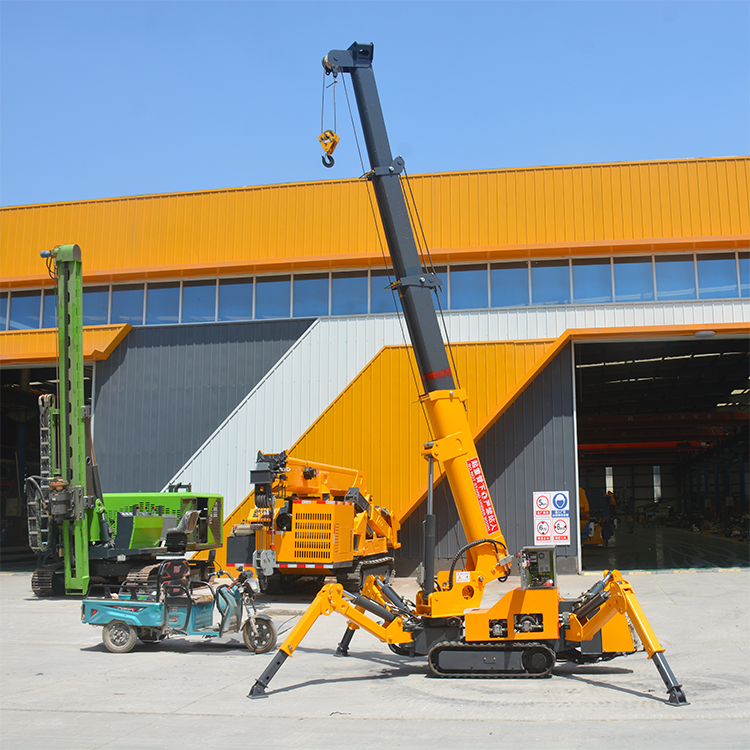
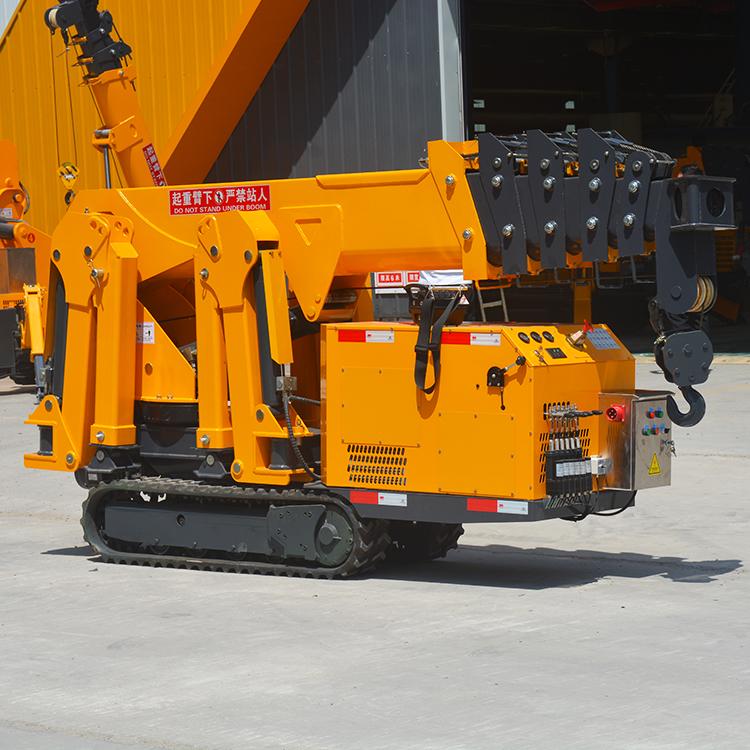
Buying a Tracked Mini Spider Crane from a China manufacturer means you stop laying plywood every time the ground gets soft. Steel tracks spread the machine's 1,300 kg across a wide contact patch, so ground bearing pressure sits near 21 kPa instead of the 70 kPa a wheeled chassis throws down. Result: turf survives, gravel holds, slopes get climbed, and setup time on unpaved sites drops by half.
Fifteen years of selling into landscaped properties taught us one thing: the ground is the customer's real concern, not the load. A homeowner does not care that the boom reached 6 metres. They care whether their lawn looks the same next Monday.
Wheels concentrate load. Four small rubber patches carrying more than a tonne each will punch through wet turf, spin on loose gravel and cut ruts in a service yard after rain. Tracks do the opposite. Our undercarriage runs 180 mm wide shoes on each side, roughly doubling the contact length compared with a wheeled frame of similar size. The arithmetic is simple. Same weight, bigger footprint, lower pressure.
Numbers we quote to buyers, taken from our own load testing:
- Machine weight with counterweight: 1,300 kg
- Total track contact area: 0.64 m²
- Calculated ground bearing pressure: about 21 kPa
- Typical wheeled competitor at the same class: 60-90 kPa
That gap is not cosmetic. Anything above roughly 50 kPa starts marking soft ground under load transfer, which is exactly when the machine rocks onto two outriggers and the pressure doubles.
There is a second benefit most first-time buyers miss. Tracks grip. When you walk a loaded machine across a heap of 40 mm crushed stone, tracks bite and hold. Wheels skim the surface, then break loose on the slightest grade change. If your sites are unpaved, this is not a refinement — it decides whether the machine is usable at all.
Tracked vs Wheeled: The Honest Comparison
We sell both. So this table is not a sales pitch — it is the sheet we walk buyers through on a call.
Criterion
Tracked Mini Spider Crane
Wheeled Spider Crane
Ground bearing pressure
18-25 kPa, spread over wide shoes
60-90 kPa on four small patches
Wet or soft ground
Travels loaded without rutting
Sinks, needs mats or boards
Lawn and turf
Shallow straight-line marks
Turf torn on any turn
Gravel and rubble
Bites and holds, self-clearing
Wheels slip on loose stone
Slope travel, loaded
Up to 25 degrees
12-15 degrees
Cross-slope limit
About 12 degrees
6-8 degrees
Indoor hard floors
Fine, slight scrub on turns
Very gentle, low friction
Transport
Ramps or a flatbed, 2.5 km/h travel
Often towable behind a pickup
Main wear items
Track tension, sprocket, rollers
Tyres and wheel hubs
Purchase cost
Slightly higher
Lower
Best fit
Gardens, earthworks, gravel yards
Finished floors, short indoor jobs
Read the last row twice. If ninety percent of your work happens on concrete and tile, a wheeled frame is cheaper and gentler. If your jobs are gardens, farms, unhardened yards, forest tracks or mountain footings, the tracked version pays for itself the first week you stop buying plywood.
One more practical note. A Tracked Mini Spider Crane is slower on the road. It walks at walking pace, so plan to move it on a small trailer or in a pickup bed for anything past a few hundred metres. That is the trade you make for the grip.
Ground Adaptation and Slope Work
Different surfaces ask different things of the undercarriage.
Turf and established lawns. Keep to long, gentle turns. Squeeze steering, do not pivot. Our rubber tracks leave a shallow straight-line impression that springs back within a fortnight in normal growing season. Turning on the spot with a load is what cuts the turf, so the manual tells operators to three-point turn instead.
Gravel and crushed stone. No preparation needed. Tracks ride over the top layer rather than ploughing into it. Clean the shoes out at the end of a dusty day, because packed material in the sprocket teeth wears the drive faster than any terrain.
Wet clay and mud. This is where tracks separate from wheels completely. If the surface is greasy, tracks spread load and keep moving. Add the optional wide shoes and the pressure drops again.
Slopes. Loaded gradeability on this machine is 25 degrees, measured on dry ground with the boom over the uphill side. Cross-slope is a much tighter 12 degrees, and that limit exists for a reason — rollover on a side slope beats any winch capacity in a risk review. We recommend an inclinometer in the cab on any site with real gradient work, and yes, we supply one.
Unhardened building plots. Common in early-stage construction and utility work. Tracks cross trenches, ride over rebar stacks and handle the sort of mess that would stall a wheeled chassis immediately.
Specifications
Track Care and Wear Points
Rubber tracks are not a lifetime part, and pretending otherwise causes arguments later. Here is our honest service picture.
Track tension. Check at mid-span every 50 operating hours. You want 12 to 15 mm of sag with the machine level and unloaded. Loose tracks derail on turns; over-tight tracks chew sprockets. Takes ten minutes with a tape and a grease gun.
Sprockets. Inspect tooth profile at 500 hours. Worn teeth ride up the track bushing and accelerate wear everywhere downstream. Replacement is a two-hour job with the track off.
Track shoes. On rubber tracks, replace the belt when the grousers are worn to about half their original height or when you start seeing cord. On steel-shoe builds, rotate and replace individual shoes instead.
Rollers and idlers. Grease the nipples every 100 hours. Seized rollers are the number one cause of premature track failure we see in the field, and it is almost always a maintenance miss, not a manufacturing fault.
Cleaning. Mud packed into the undercarriage during a wet season rusts pins and stretches belts. Pressure-wash after wet work. Sounds fussy; saves thousands.
We keep sprockets, rollers, idlers and complete track belts for the common frames in stock and can air-freight a belt inside a week if a machine is standing still. JOJOmechanical service kits ship with a laminated torque and interval sheet so the operator on site is not guessing.
FAQ
Q: Will a Tracked Mini Spider Crane damage my lawn or paving?
A: Straight-line travel over healthy turf leaves a shallow mark that recovers quickly. Spot turns under load are what cut grass, so steer gently. On paving, use pads under the outriggers and avoid pivoting on the spot; the tracks themselves are rubber and will not chip slabs.
Q: How long do the rubber tracks last, and what does a replacement cost?
A: On mixed ground, expect 1,500 to 2,500 hours from a quality belt. Gravel and rubble shorten that; clean concrete lengthens it. Tension discipline matters more than brand. We publish belt, sprocket and roller pricing in our spare-parts list, so you can budget before you buy the machine.
Q: How steep a slope can this machine climb while carrying a load?
A: Twenty-five degrees loaded on dry, firm ground, with the boom kept over the uphill side. Cross-slope is limited to twelve degrees. If your site exceeds that, tell us — we would rather spec you the right machine or a winch-assist setup than have you learn the limit the hard way.