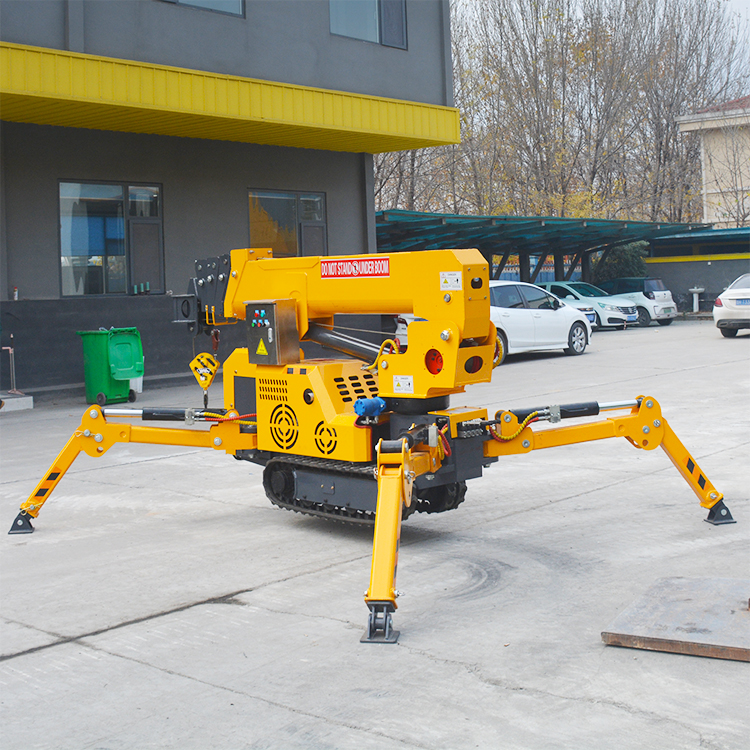
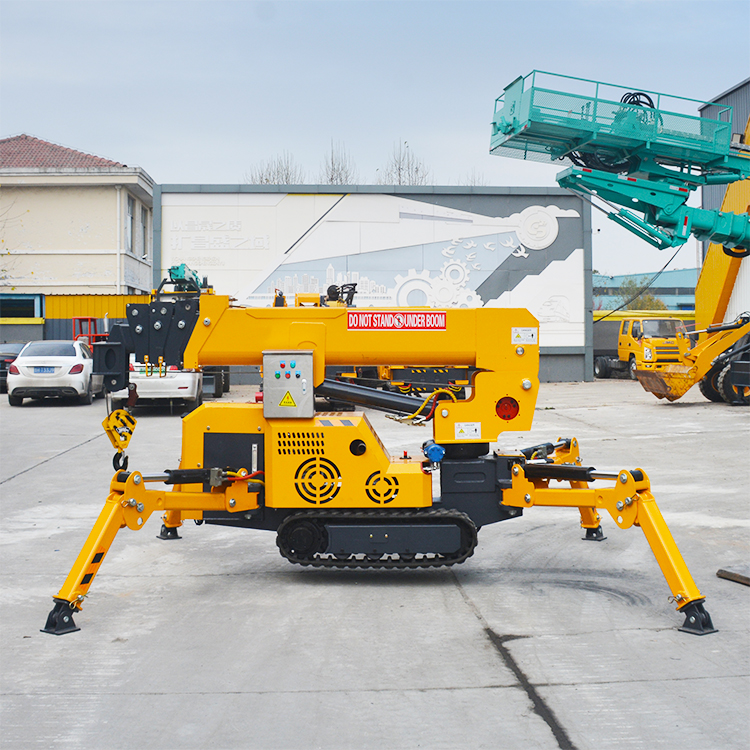
Sourcing a Construction Mini Spider Crane from a professional China supplier is mainly about two things: cycle time, and whether the safety paperwork holds up. This 2-tonne machine lifts materials from ground to any floor in one pick, sets up in under 15 minutes on a 3 m footprint, and ships with a third-party load test certificate that a main contractor can file without a fight.
Walk any mid-rise site at 7 a.m. and watch the bottlenecks. They are never where the planner thinks.
The tower crane is booked solid for structural steel until noon. The materials hoist has a queue eight loads deep. Labourers are hand-carrying plasterboard up two flights because the lift is out for service. Nobody can get a pallet of blockwork onto the third-floor slab before the mason crew arrives.
That is the daily reality on projects running between two and eight storeys. The big crane is available, just not for anything small. And small loads are most of what a fit-out actually consumes — lintels, bags, boards, bracketry, plant units, formwork panels, rebar bundles.
This is the gap a Construction Mini Spider Crane fills. Not replacing the tower crane. Picking up the hundreds of lifts the tower crane should never have been asked to do.
We hear the same complaints from site managers:
Losing half a morning to a lift that takes four minutes.
Damaged material because it was dragged instead of lifted.
Rework when something went up the wrong stairwell.
Near-misses from improvised manual handling on stairs and scaffold.
Add a compact machine with its own rated lifting chart into that picture and most of those problems simply stop being scheduling items.
There is a commercial argument too. On our own customers' numbers, one machine working a normal shift replaces roughly four to six labour-hours per day of manual material movement, and it does it without the back-injury risk that manual handling carries. On a twelve-week fit-out that is a meaningful line in the cost plan.
Lifting Scenarios From Ground to Top Floor
Five jobs cover the majority of construction use.
Ground to slab edge. Machine parks at the building perimeter, boom reaches over the edge, load lands inside the slab. With a 12.5 m lift height and 11 m working radius, this covers most low- and mid-rise floor levels in a single pick. Use the anti-two-block and keep the load inside the chart for the radius you are actually working at.
Scaffold outside, load in. Where scaffolding is already standing, the crane can reach between standards rather than over them. Coordinate with the scaffold designer, because the machine does not touch the scaffold — it works beside it. That distinction matters in the method statement.
Materials hoist feed. Instead of the tower crane feeding the hoist, the mini unit lifts directly and skips a queue.
Internal fit-out. Once the envelope is closed, a Construction Mini Spider Crane rolls in through a service entrance, sets up on the finished slab with pads, and lifts plant, risers, ductwork sections and ceiling units. It works under a 2 m headroom for low-level placement and within a normal floor-to-soffit height once the boom is raised.
Restricted-access fronts. Basement pits, podium decks, courtyards and back-of-house service yards where nothing with a road registration can reach. These are the picks that otherwise end up as a plan revision.
Practical field note from our own install visits: the biggest time saver is not lifting speed, it is where you park. Position the machine so one setup covers the whole floor plate. Moving a compact crane takes minutes, but doing it three times a shift still adds up to an hour nobody budgeted for.
Safety Devices That Earn Their Place
Site safety is not a marketing feature list. It is the difference between a machine a principal contractor signs off and one that sits in the yard. Every unit we build for construction work carries:
Device
What it prevents
Moment limiter / rated capacity indicator
Overload at long radius, the most common cause of tip-over
Anti-two-block system
Hook block hitting the boom sheave, rope snap and dropped load
Outrigger interlock
Lifting before all four legs are set and pinned
Tilt / level alarm
Operating on an out-of-level slab or soft pad
Boom and slew lock
Uncontrolled movement during travel and transport
Emergency stop, cab and base
Shutting down from either control position
Hydraulic lock valves on cylinders
Load creep if a hose or seal fails
What most buyers do not ask about, and should: how the limiter is calibrated and who can adjust it. Ours are factory set and sealed. Changing the calibration voids the load test certificate, and any site that audits your paperwork will notice.
We also supply a document pack with every construction-spec machine — load chart, operation manual in English, hydraulic schematic, maintenance schedule and the third-party load test report. If a main contractor wants EN 13001 references or GB/T 3811 alignment in the method statement, those documents are the ones they will ask to see.
Load chart, English manual, load test report, hydraulic schematic
Standards
CE-marked components, ISO 9001 factory process
Transport
3.5 t trailer or flatbed; 1 unit per 20 ft container
Site Checklist Before the First Lift
Print this, laminate it, keep it on the machine. Every one of these has caused a real incident somewhere.
Confirm the ground. What is under the outrigger pad — slab, backfill, paving over void? If in doubt, spread the load on timber or steel plate.
Set all four outriggers, then check the level. All four. Not two, not three.
Check the load chart for the radius you are actually working, not the radius you hoped for.
Inspect rope, hook latch and sheave before the first lift of the day.
Brief the banksman. Agreed hand signals, or a radio channel if the load is out of sight.
Cordon the fall zone and the swing radius. Never let anyone walk under a suspended load.
Keep the load within the machine's rated capacity with a margin. Ten percent headroom is not timid, it is professional.
Watch wind. Above roughly 12 m/s, stop lifting anything with a large surface area — glass, boards, panels.
Never use the crane to drag, pull or free a stuck load. That is how booms bend.
Log it. Hours, lifts, anomalies. The log is what tells you a hydraulic issue is developing rather than suddenly appearing.
Operator Training and Competency
A compact spider crane is easy to run and easy to run badly. The difference is training.
What we recommend, and what our construction customers generally require:
A recognised lifting operator competency for the jurisdiction — the machine class is usually covered by the same certification route as mobile cranes or materials handlers, so check local rules before assigning staff.
Two to three days of supervised familiarisation on the actual unit, covering setup, chart reading, load control and shutdown.
A written in-house method statement for the specific site, not a generic one from a previous project.
Annual refresher, plus a re-brief whenever a new attachment is introduced.
JOJOmechanical provides a commissioning session at our facility or via video walkthrough at the customer's site before the machine goes to work, covering setup sequence, safety systems, daily checks and the three most common operator errors we see on first delivery. Remote support stays open through the warranty period.
FAQ
Q: Should I choose the diesel or the electric version for construction work?
A: Diesel for outdoor sites with no power and long shifts, since you never want a lift delayed by a battery. Electric for fit-out, basements and any enclosed or noise-sensitive work where exhaust rules the machine out. Many of our construction buyers order the dual diesel-electric build precisely because sites change phase mid-project.
Q: What operator qualification does a spider crane need?
A: Requirements vary by country and sometimes by site. As a rule, treat it as a lifting machine and assign a trained, certified operator with a documented competency for the class. We supply the load chart, manual and training materials your safety officer needs; the certification itself must come from a recognised local body.
Q: What safety devices come as standard?
A: Moment limiter with rated capacity indication, anti-two-block, outrigger interlock, tilt alarm, boom and slew locks, emergency stop from both control positions, and hydraulic lock valves on the lift cylinders. The limiter is factory calibrated and sealed, and the calibration record travels with the machine.