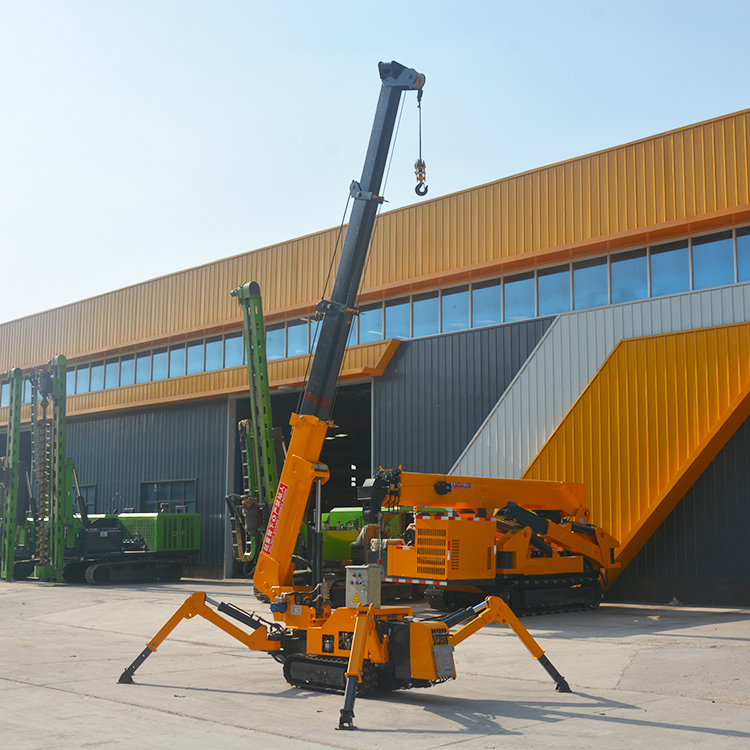
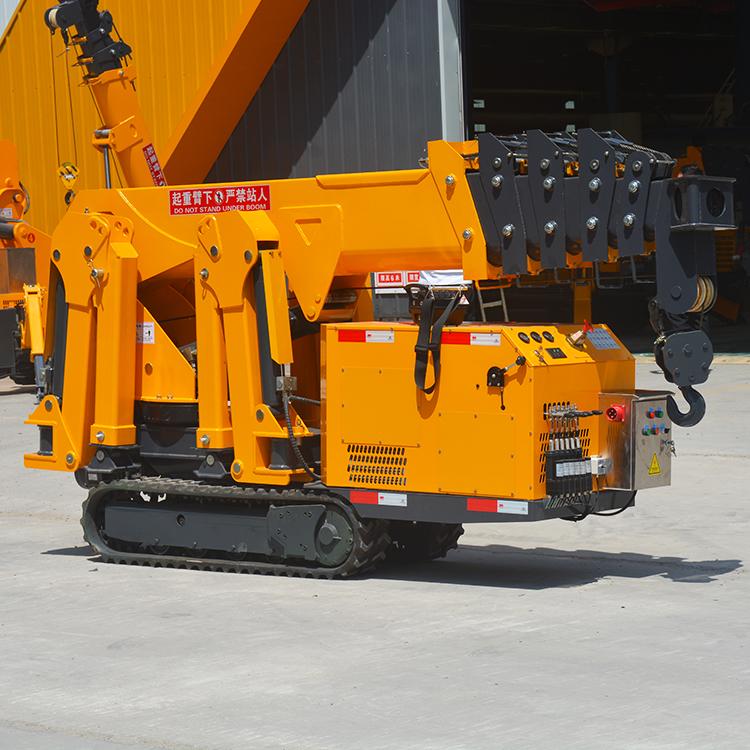
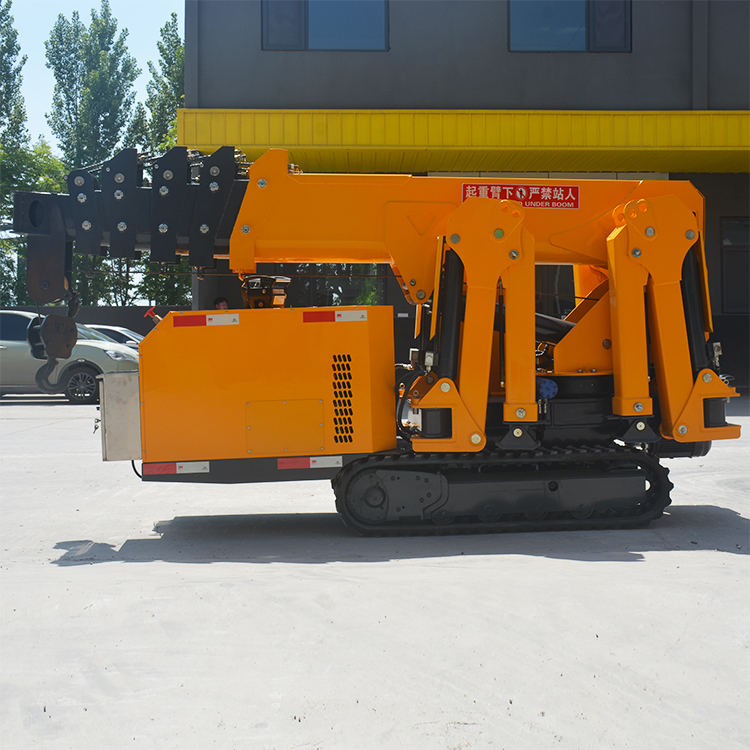
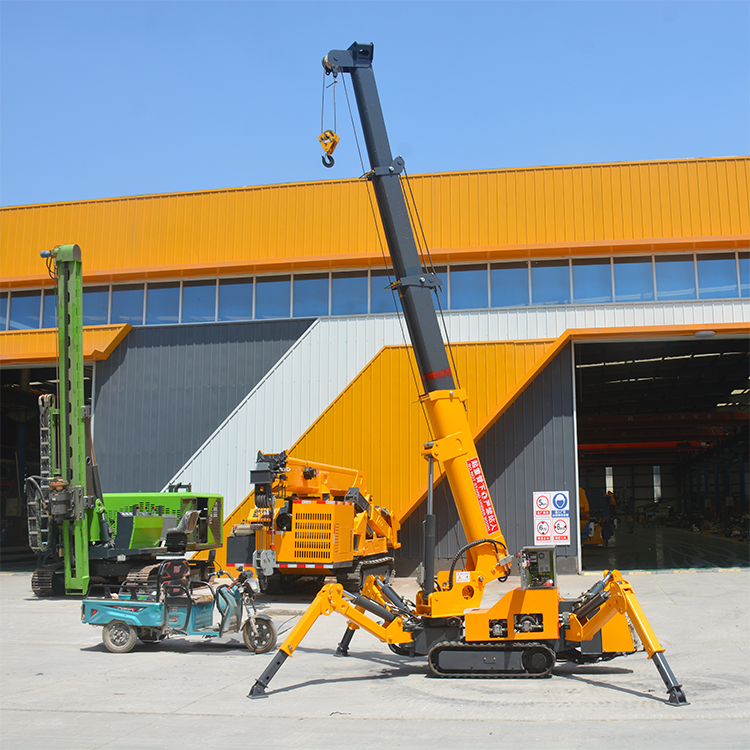
As a China manufacturer of the 1.5 ton spider crane, JOJO Machinery builds this unit for crews that need a real lift inside a finished building. Rated 1.5 t, with a 6 m working radius, 6.5 m lift height and 1.7 t dead weight on a 2 m four-section boom. Send the lift list and the narrowest opening on site, and the quotation goes out factory-direct.
A 1.5 ton rating is not a small crane. It is the smallest size that still handles a full glass panel, a pallet of tiles or a rooftop plant unit, and it is the size most of our repeat buyers settle on after renting something larger for a season.
Here is the arithmetic we go through with a buyer. A double-glazed curtain wall panel runs 150 to 250 kg. A three-metre lift of steel profile stays under 300 kg. A split air-conditioning condenser is 90 to 130 kg. A small generator set rarely passes 800 kg. Between them those loads cover most of the work a spider crane is actually hired for, and they all sit inside a 1.5 t envelope with margin left for the slings, the hook block and the honest losses that come with radius.
Above that, our range runs to 16 t. This unit sits at the bottom of a family that shares one design logic: tracked undercarriage, four outriggers, a multi-section hydraulic boom, and a rated capacity that falls as the radius grows. Whether you need this size or the one above it usually comes down to a single number, the heaviest piece you have to put in the air at the furthest point you have to reach it.
Boom, Outriggers And The Geometry Behind The Rating
Two metres folded, four sections, 6.5 m of reach in 20 seconds. That is the telescopic package here, and it is deliberately conservative. Four sections instead of five keeps the folded length short and the boom nose light, which matters when two men have to push the machine through a narrow opening before it does any lifting.
The boom luffs from 0 to 78 degrees in about 13 seconds, and the turret turns 360 degrees continuously in roughly a minute, so the machine does not need repositioning between picks on the same face of a building. Continuous slew sounds like a comfort feature until you watch somebody work a roofline: stopping at the end of travel, backing up and resetting the outriggers costs more time than the lift itself.
Outriggers decide whether a spider crane works or does not. Ours are three-section legs, manual screw-out with hydraulic automatic support, spreading to 3,600 mm along the machine and 3,400 mm front and rear. That spread is what turns a 1.5 t rating into something you can trust on a suspended slab, and it is also why the machine needs a clear rectangle around it before the first pick.
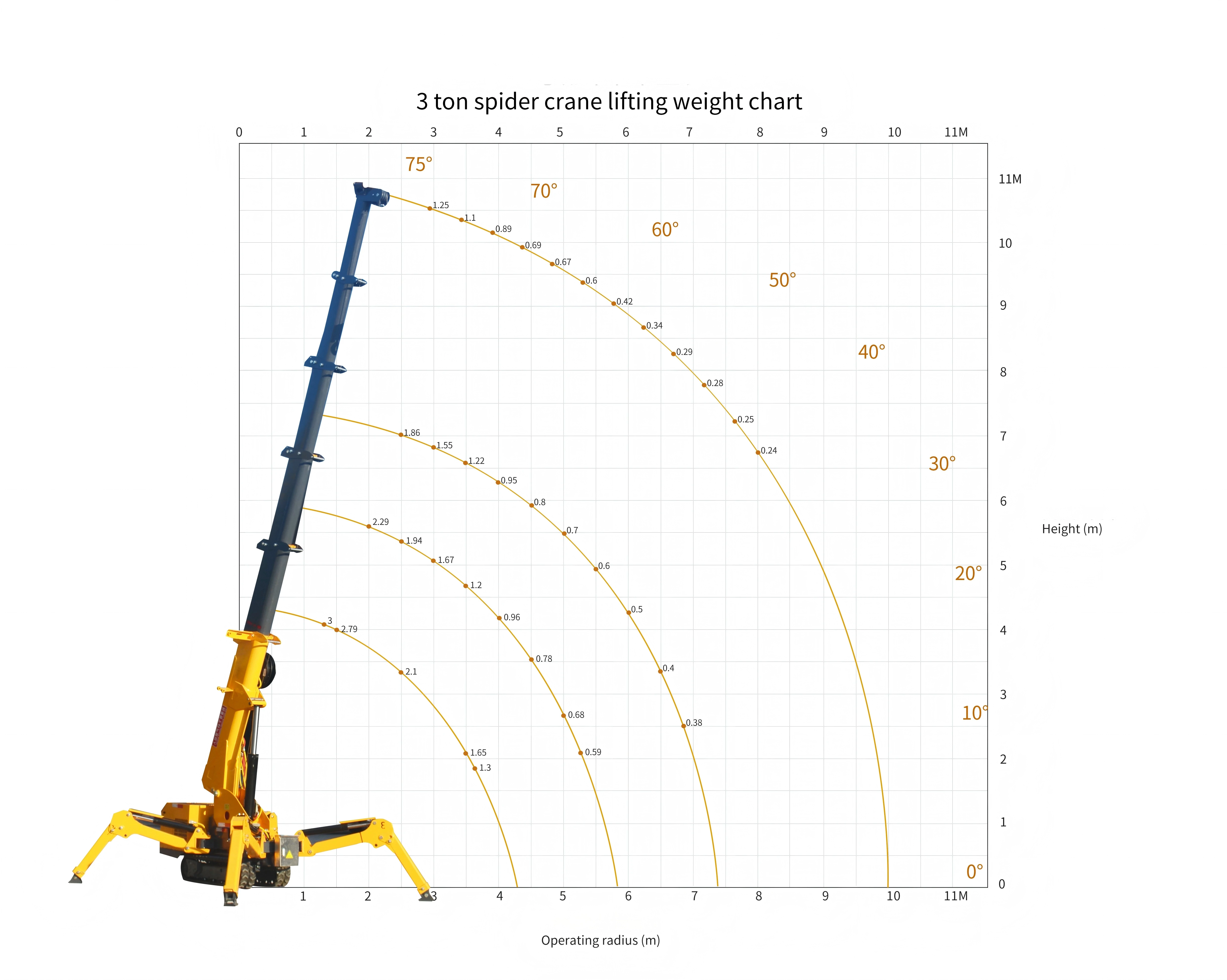
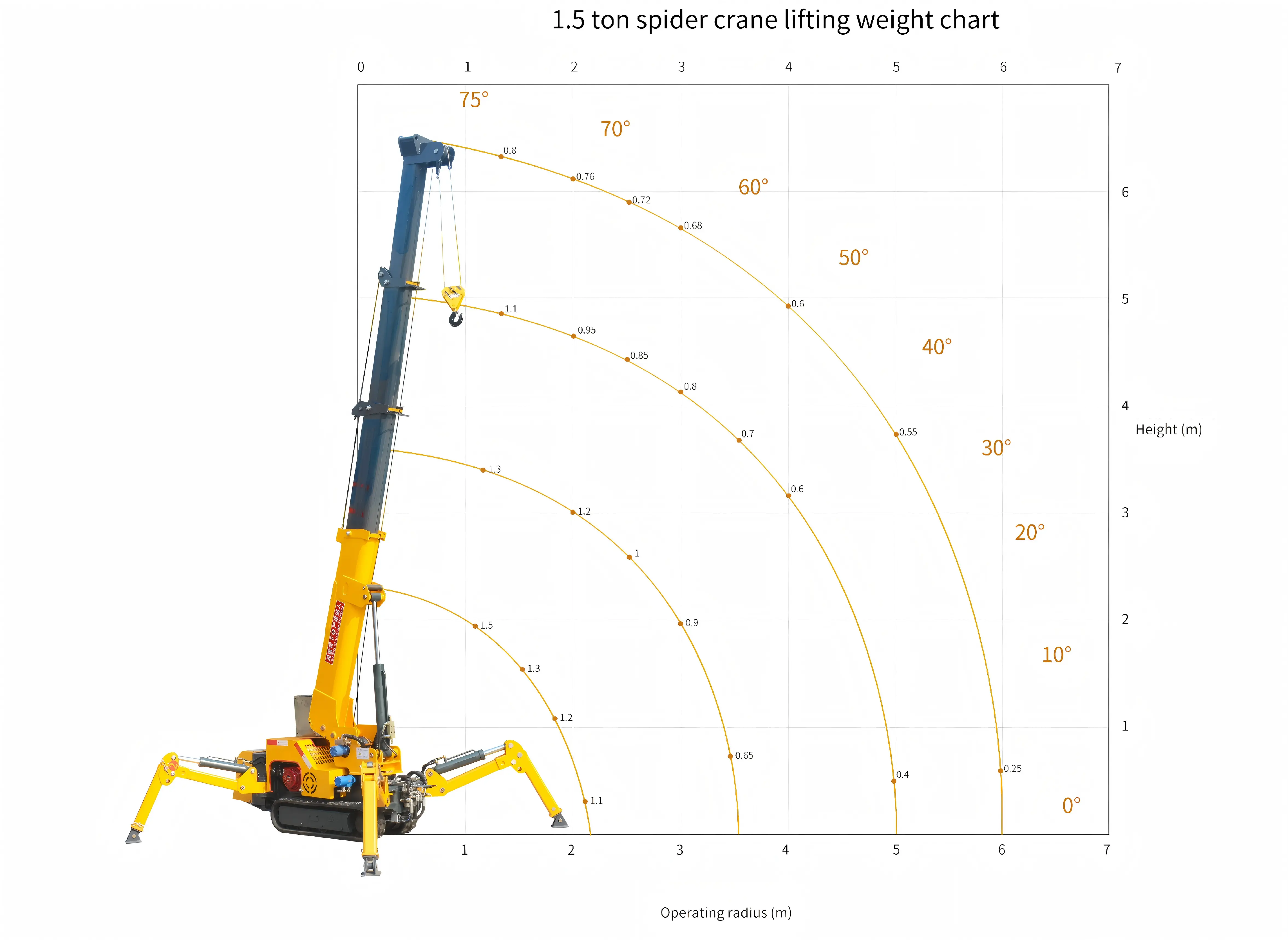
We publish a load chart rather than one number, because capacity depends on radius and boom angle. Close in, the machine lifts well above its rating.(the machine lifts with ease, getting the job done even better than expected.) At 6 m it does not. Anyone quoting a spider crane as a flat figure has not read the chart, and the chart that ships with this unit is the one to quote from.
The Chassis: Tracks, Speed And Gradeability
Hydraulic drive, 0 to 2.5 km/h, gradeability of 25 degrees (46.6 percent), rubber tracks 180 mm wide on a 72 mm pitch. Those four numbers describe how the machine reaches the lift, and for most buyers they matter more than tonnage.
Tracks rather than wheels for two reasons, ground pressure and control. A wheeled carrier needs a hard surface and a turning circle. A tracked machine at 1.7 t crawls across a lawn, a gravel path, a kerb ramp or a polished warehouse floor without asking permission, and the hydraulic drive holds it on a slope while the operator sets the legs.
Track width is worth checking against your own site. At 180 mm per track with a 72 mm pitch, the footprint is narrow enough for garden gates and service corridors, and the track sections are a standard pitch, so replacement pads are not a special order.
Engine, Fuel And What It Costs To Run
Power comes from a Honda 390CC gasoline engine as standard, with diesel available on the same mount. Electric start, rated starting performance from -50 C to +45 C, an 8 L fuel tank, a 12 V 45 Ah battery, fuel consumption of about 274 g/kW-h, and a measured noise level below 81.5 dBA at one metre.
In plain terms that is a small engine burning roughly a litre an hour under load. Owners tell us the fuel bill disappears next to what a crane hire firm charges for a half day, which is the whole economic argument for owning one of these instead of renting.
For indoor work, or any site that bans petrol engines, the 1.5 ton spider crane is built with AC380V electrical machinery. The power source can be matched to the building rather than the other way round, and that single option is why a number of our units end up working inside shopping centres and factories.
Photo: Engine compartment, battery and fuel system
Controls: Manual As Standard, Remote As An Option
Boom and outrigger functions are operated manually as standard and walking is manual too. Remote control is an option, quoted honestly as an option rather than buried in the brochure as a feature.
The panel is labelled in plain English: FORWARD and BACK OFF for the hook, WALK with TURN LEFT and TURN RIGHT, OUTRIGGER, BOOM LIFTING, ARM DROP, HOOK UP and AMPLITUDE. Nothing hidden behind icons, nothing that needs a two-day course to decode.
We recommend the remote in two cases: when the operator needs to watch the load instead of the machine, and when the boom is working over anything expensive. Both come down to sight lines, and sight lines are the one thing a spider crane cannot give you from a fixed seat.
Specifications
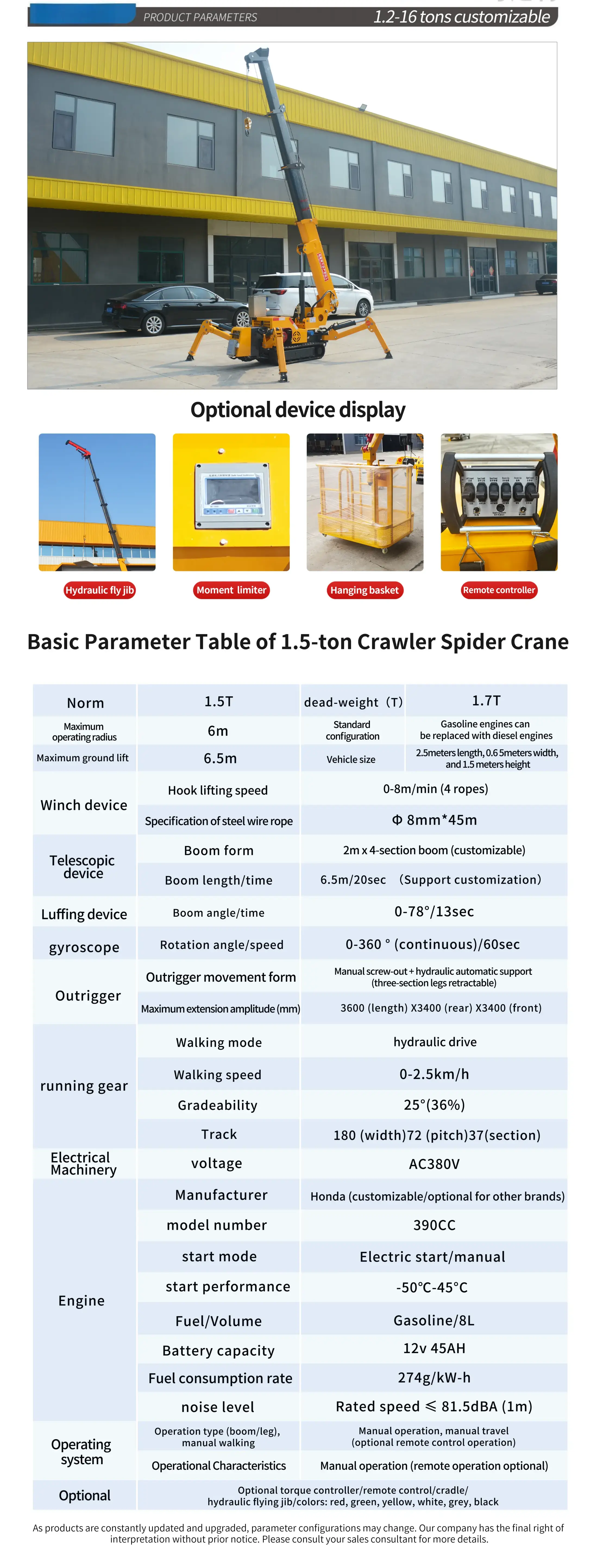
Figures below are for the standard 1.5-ton crawler spider crane. Configurations are customisable, and anything marked optional is quoted as a separate line rather than assumed.
Item
1.5 Ton Spider Crane
Note
Rated capacity
1.5 t
Customisable range 1.2 t to 16 t
Dead weight
1.7 t
Transport and floor loading
Maximum operating radius
6 m
Capacity falls with radius
Maximum lifting height
6.5 m
From ground level
Hook lifting speed
0-8 m/min
Four ropes
Wire rope
8 mm x 45 m
Winch device
Boom form
2 m x 4 sections
Customisable
Telescopic speed
6.5 m in 20 sec
Support customisation
Luffing
0-78 degrees in 13 sec
Boom angle and time
Slewing
0-360 degrees continuous, 60 sec
Full rotation
Outriggers
3-section legs, manual screw-out + hydraulic automatic support
Products are updated continuously, so parameter configurations may change without prior notice. Confirm the final specification with your sales consultant before ordering.
Options Most Buyers Add
Four optional devices come up again and again. The torque controller is the one we push hardest, because a limiter that cuts the lift before the machine tips is cheaper than the repair that follows. The remote control suits operators who work alone. A cradle or man basket turns the machine into an access platform for facade work. A hydraulic flying jib adds reach at a fixed radius for awkward rooflines.
Colour is not cosmetic for fleet buyers. Machines painted red, green, yellow, white, grey or black can be matched to a company livery or split by site, and paint is applied before assembly so the finish lasts longer than a workshop respray.
Where A 1.5 Ton Spider Crane Earns Its Keep
Glass and curtain wall work is the classic job. Panels arrive on a lorry and have to go up a facade or through an opening that a truck crane cannot reach, and the machine sets up under the hoist line rather than in the street.
Rooftop plant is the second. Condensers, air handling units and solar gear are heavy enough to need a machine and light enough to suit this size, and the outrigger spread can be set on a roof deck rather than on the ground.
Indoor and warehouse work follows: machinery moving, pallet lifting, installation inside factories and shopping centres, with the AC380V option removing exhaust from the equation. Renovation projects use the same machine to lift material over a finished building rather than through it. Landscapers and garden contractors use it for trees, stone and water features where a wheeled machine would leave ruts.
FAQ
1.Q: How much can it actually lift at full radius?
A: Less than at close radius, and the load chart is the authority. At 6 m the capacity is a fraction of the 1.5 t rating. Give us the weight and the radius and we will confirm the pick against the chart before you order.
2.Q: Can it be used inside a building?
A: Yes, with the AC380V electrical machinery option. The standard gasoline engine should only run in ventilated areas, which is why the electric power source exists.
3.Q: Does it fit through a standard doorway?
A: Folded, the machine is 2.5 m long and 1.5 m high, with track width to match your access. Send the narrowest opening and we confirm it against the drawing rather than guessing.
4.Q: Is remote control included?
A: It is optional. Manual operation is standard for the boom, the legs and travel. Remote control is quoted as an option and can be ordered with the machine or added later.
5.Q: What is the lead time and the payment terms?
A: The standard build ships 30 to 35 days from order confirmation, and customised configurations add 10 to 15 days. Terms are 30 percent deposit with the order and 70 percent against shipping documents, by bank transfer or letter of credit.