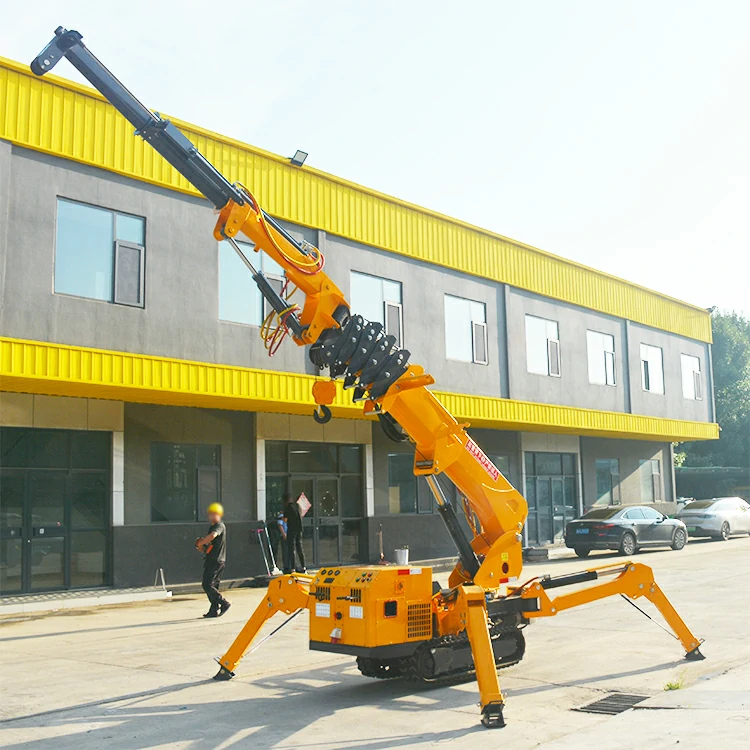
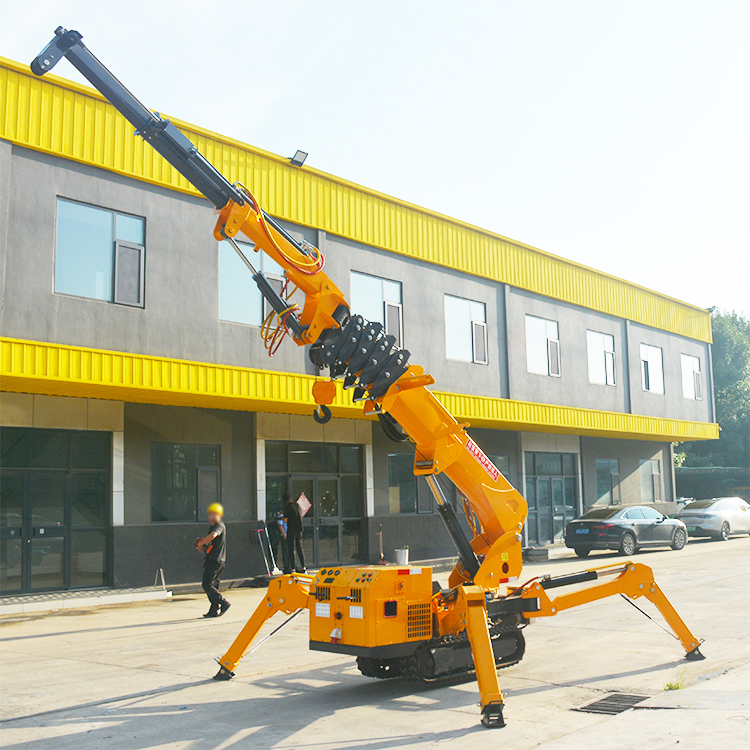
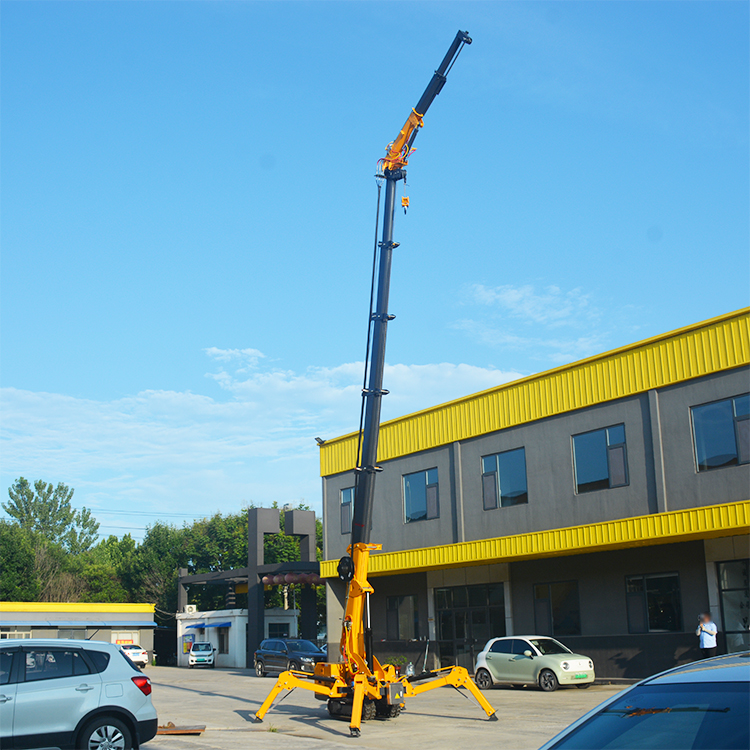
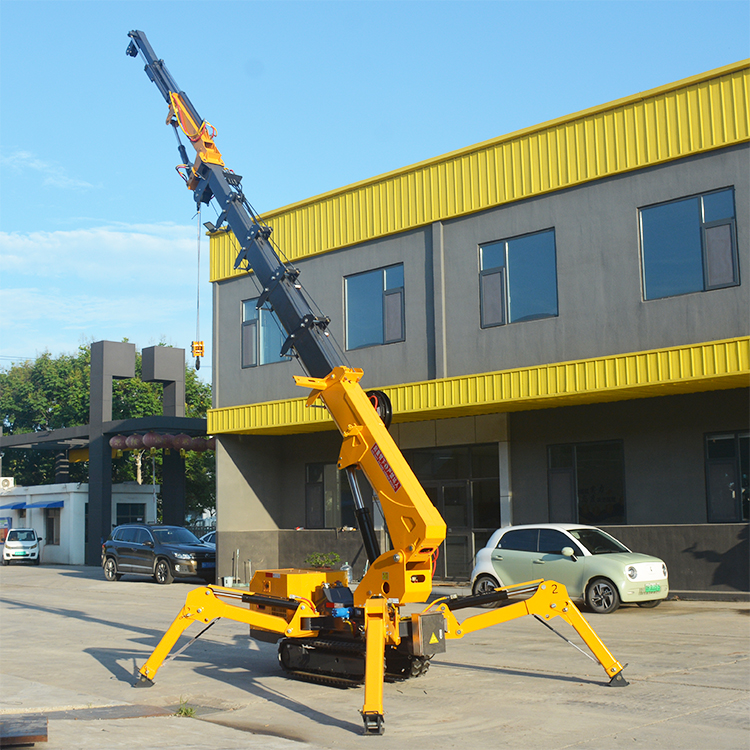
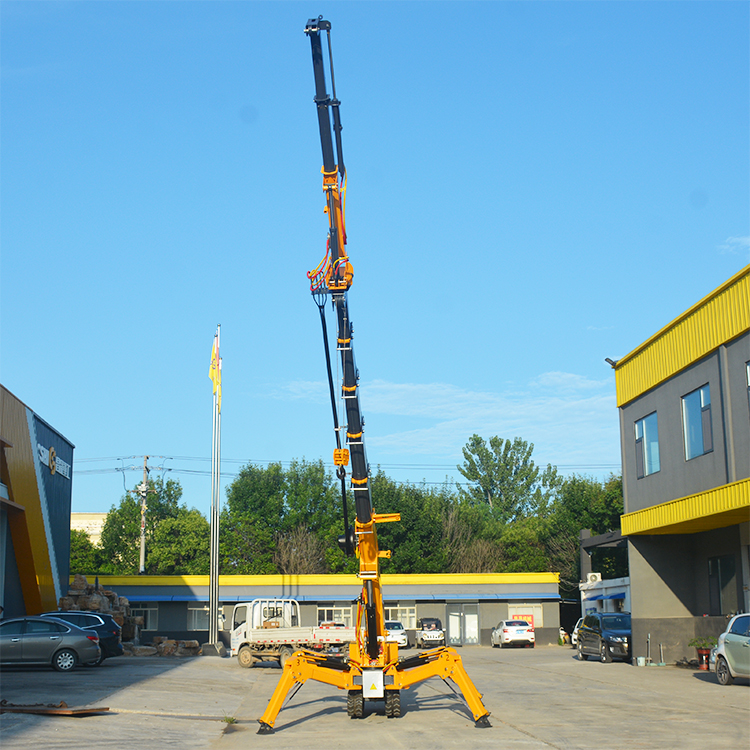
The 3 ton spider crane from JOJO Machinery, a China factory-direct manufacturer, is the size we ship most often to glazing and steel-erection crews. It carries a six-section boom out to 10.8 m of lift height and 10 m of working radius in a body 0.8 m wide, with diesel and electric power fitted as standard. Ask for a quotation with your lift list.
Three tonnes buys reach in this class, not tonnage. The chart tops out at 10.8 m of lift height and a 10 m radius, which is a different job from anything the smaller units can attempt: three storeys of facade, a roof plant room, or a steel frame assembled above a finished ground floor.
Six boom sections deliver that height in a 2.4 m folded package. The trade-off is honest and worth stating. A six-section boom has more sliding interfaces than a four-section unit, so the maintenance schedule includes checking wear pads and keeping the boom clean. In return the machine folds into a body 0.8 m wide, which is what gets it inside a shopping centre without dismantling a shopfront.
We build it for crews who spent last season lifting with a truck crane and a man basket. Three tonnes and 10.8 m covers the great majority of that work with one operator and no outrigger pads on public paving.
Reach, Boom Speed And Cycle Time
The boom runs from 3.1 m to 10.8 m in about twenty seconds, luffs from 0 to 78 degrees in thirteen, and the turret turns continuously through 360 degrees in a minute. Cycle time matters more than peak figures on a facade job: a crew making thirty picks in a morning feels every extra second of boom travel.
Rope is 8 mm by 45 m, reeved four-part, and the hook moves at 0 to 8 m/min. Slow enough to set a panel down without shock loading, quick enough that the crew is not waiting on the winch.
Dual Power: Diesel And Electric On One Machine
This is the specification point that decides most orders. Power comes from a Changchai three-cylinder unit at 14.7 kW on diesel, with an AC380V motor as the second source. Outside on fuel, inside on mains, driven from the same control set.
Diesel consumption sits at 12 L of fuel with consumption around 274 g/kW-h, starting reliably from -50 C to +45 C on a 12 V 45 Ah battery. Noise at rated speed stays below 81.5 dBA at a metre. For any project where the machine has to cross between a site yard and a finished interior on the same day, order it with both power sources; a conversion later costs more than the option.
Outriggers, Floor Loading And Steel Tracks
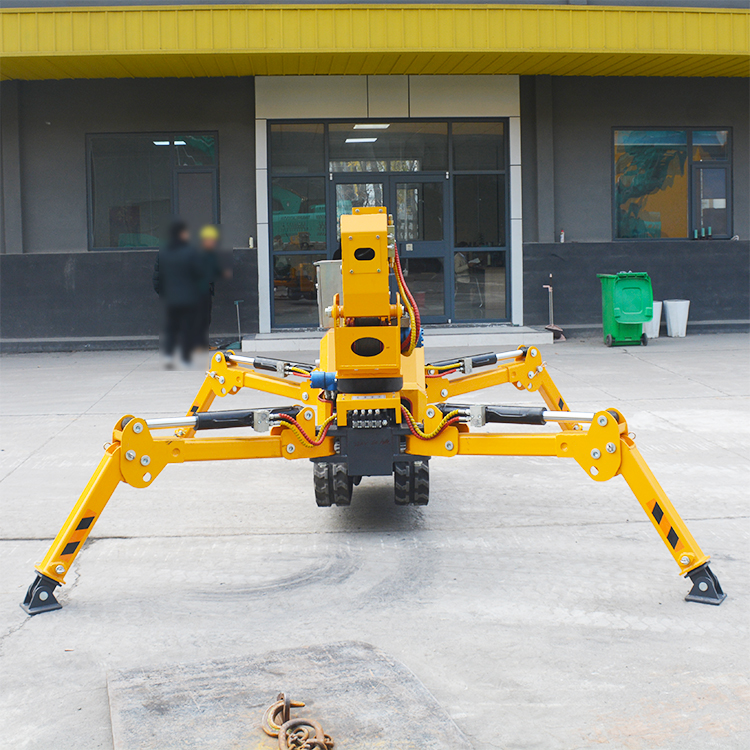
Legs are three-section, hand-screwed and hydraulically locked. They extend to 4,300 mm at the front and along the machine, 3,700 mm at the rear. That spread is what makes the rating usable on a suspended slab, and it is the first thing a structural engineer asks about.
The carrier runs on steel tracks 220 mm wide on a 72 mm pitch, 50 sections per side, hydraulically driven at 0 to 2.5 km/h with 25 degrees or 36 percent of gradeability. Steel rather than rubber because this machine works on gravel, mud and demolition sites more often than on finished floors. Folded, the complete unit measures 3.5 m long, 0.8 m wide and 1.85 m high.
Specifications
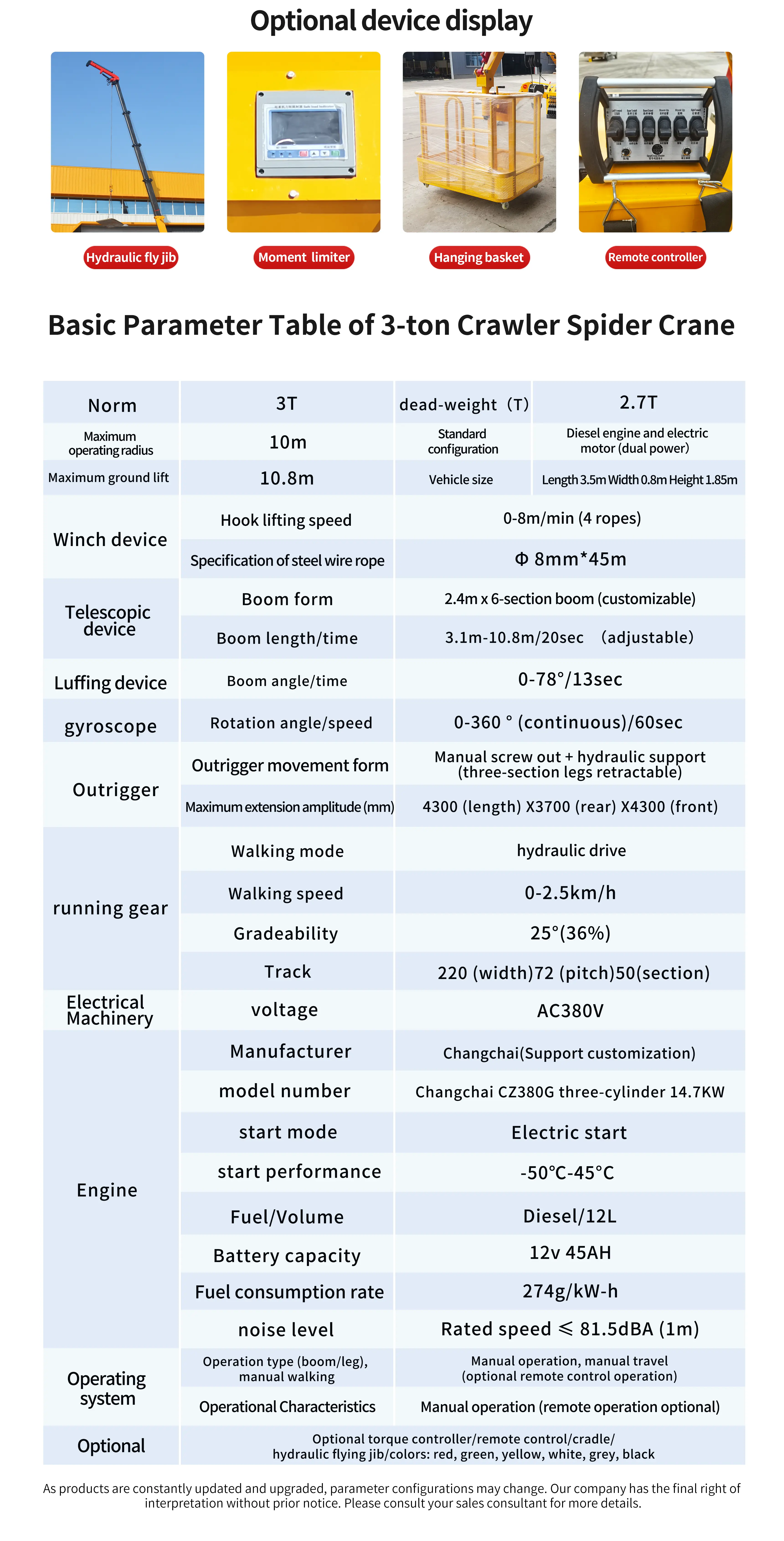
Figures below describe the standard 3-ton crawler spider crane. Customisation is available across the range from 1.2 t to 16 t, and optional devices are quoted separately.
Item
3 Ton Spider Crane
Note
Rated capacity
3 t
Dead weight 2.7 t
Maximum operating radius
10 m
Capacity falls with radius
Maximum lifting height
10.8 m
From ground level
Hook lifting speed
0-8 m/min
Four ropes
Wire rope
8 mm x 45 m
Winch device
Boom form
2.4 m x 6 sections
Customisable
Boom length and time
3.1 m to 10.8 m in 20 sec
Adjustable
Luffing
0-78 degrees in 13 sec
Boom angle and time
Slewing
0-360 degrees continuous, 60 sec
Full rotation
Outriggers
Three-section legs retractable, manual screw-out with hydraulic support
Automatic support
Outrigger extension
4,300 mm length, 3,700 mm rear, 4,300 mm front
Maximum
Travel
Hydraulic drive, 0-2.5 km/h
Gradeability 25 degrees (36 percent)
Tracks
220 mm width, 72 mm pitch, 50 sections
Steel
Machinery voltage
AC380V
Mains operation
Engine
Changchai CZ380G three-cylinder diesel, 14.7 kW
Dual power with electric motor
Starting
Electric start, -50 C to +45 C
Rated performance
Fuel and tank
Diesel, 12 L
274 g/kW-h
Battery
12 V 45 Ah
Standard
Noise
Below 81.5 dBA at 1 m
Rated speed
Vehicle size
3.5 m long, 0.8 m wide, 1.85 m high
Folded
Operating
Manual boom and legs, manual travel
Remote control optional
Product parameters are updated as the range develops. Confirm the final configuration with your sales consultant before the order is placed.
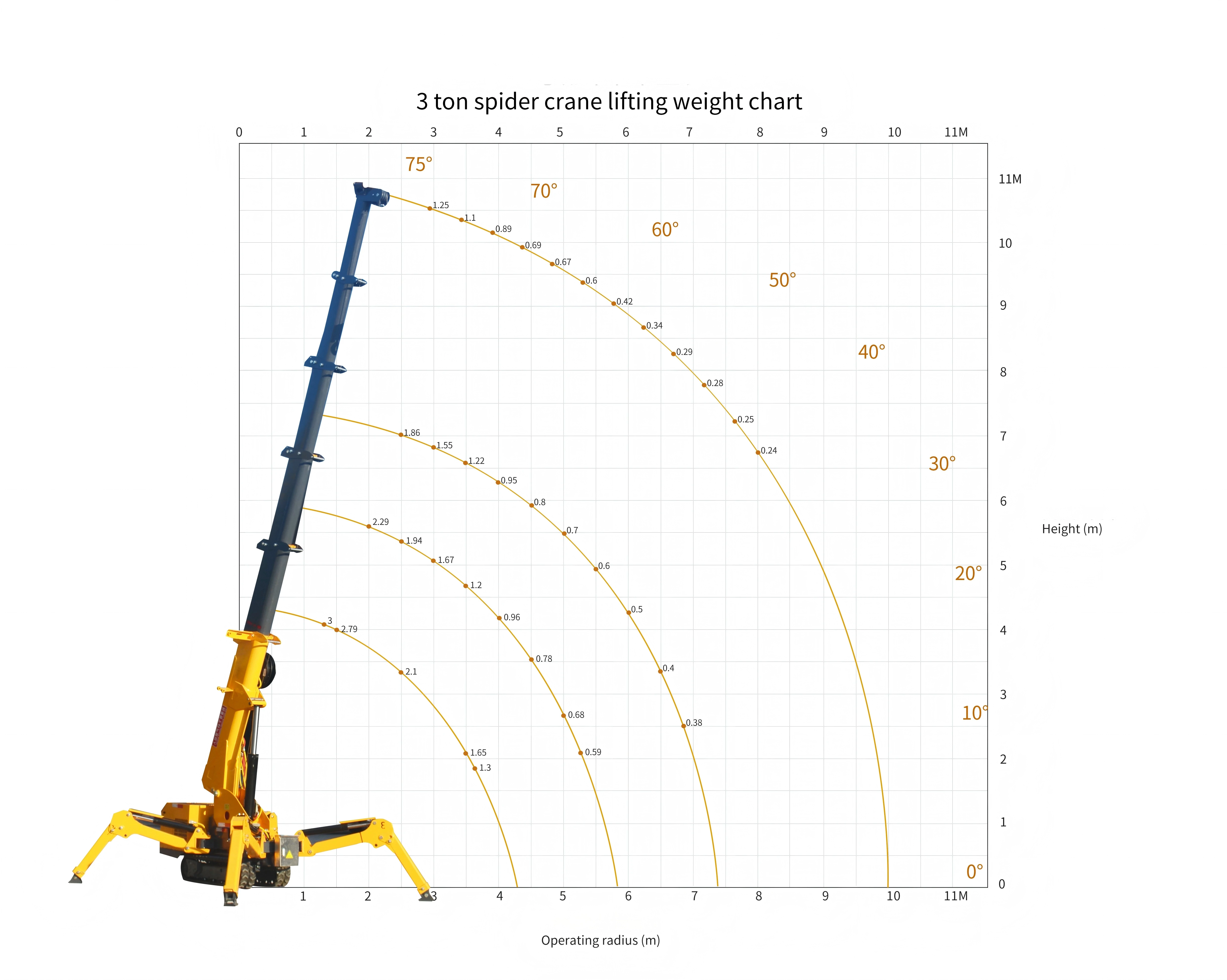
Lifting weight chart
Optional Devices We Build On Request
Available options: torque controller, radio remote, cradle, hydraulic fly jib. On export machines we fit the torque controller as a matter of course: it cuts the lift before the machine reaches its tipping moment, and on a three-tonne unit working at 10 m the margin is not something to judge by eye. Colours are red, green, yellow, white, grey or black, sprayed before assembly.
Where Three Tonnes Fits
Curtain walling across three storeys. Roof plant replacement on occupied premises. Steel frames and precast elements on domestic extensions and small commercial builds. Glass units that are too heavy for a two-tonne machine but too awkward for a lorry-mounted crane to reach. Machinery installation inside industrial units, run on mains power with the electric motor.
FAQ
Q: What does a 3 ton spider crane lift at 10 m? A: Less than at close radius. The load chart is the authority and we check your heaviest pick against it before quoting, including the weight of slings and hook block.
Q: Can it work indoors? A: Yes. Inside, the AC380V motor takes over; outside, the diesel. Both sources are standard on this machine rather than an add-on.
Q: How wide is it when folded? A: 0.8 m wide, 3.5 m long and 1.85 m high. That width is what lets it pass through a narrow service door or between racks in a warehouse.
Q: Steel tracks or rubber? A: Tracks are steel, 220 mm wide, a choice made for gravel and demolition work. Rubber pads are available where the machine has to run on finished floors.
Q: What are the payment terms and lead time? A: Three to four weeks for a standard machine, plus two weeks where options are added. Terms are 30 percent on order and 70 percent against documents, by T/T or L/C.
Q: How is the machine supported after delivery? A: Exploded-view parts catalogues ship with the unit, wear parts are held for ten years, and consumables such as filters and seals are standard metric items available locally.
Ordering
Send the lift list with weights and radii, the maximum height, the narrowest access, the ground under the outriggers and the power available on site. With those five answers and the destination port we return a quotation with the options broken out line by line. Minimum order is one unit, and machines ship in sea-freight crates with the boom secured and the outriggers retracted.